
Outer annulus
The fibrous outer disc is one anatomical structure a procedure claim may reference.
The clinical question: How is the target defined, and is the proposed effect theoretical or clinically demonstrated?
Spine + disc evidence review
A product and diagnosis specific review of fibrin based intradiscal approaches. “Solidifying” a disc is not a medically responsible outcome promise.
Explore available care
A useful place to begin
Fibrin helps the body form a clot. That role does not tell us whether a particular fibrin preparation can help a painful spinal disc. If you have been told a disc can be sealed or stabilized, ask what those words mean for the proposed product and your diagnosis. This guide helps separate the idea behind a procedure from what has been shown in people.
What it means
Fibrin is a protein involved in blood clotting and can be used in certain medical sealants. Fibrin based materials have also been studied for intradiscal use, but products, techniques and study populations vary.
The phrase “fibroid injection” appears to be a terminology error and should not be used for a spinal disc procedure. The exact material, manufacturer and intended clinical use must be confirmed before patient facing claims are made.
Clinical questions
Risks + limits
Possible risks of an intradiscal injection include infection or discitis, bleeding, nerve or tissue injury, inflammatory or allergic reaction, increased pain, no benefit and need for further treatment. Evidence remains limited and conclusions may differ by technique.
Alternatives
Depending on the diagnosis and severity, alternatives can include rehabilitation, activity modification, medication, other image guided procedures, multidisciplinary pain care, surgical consultation or continued observation.
The anatomy
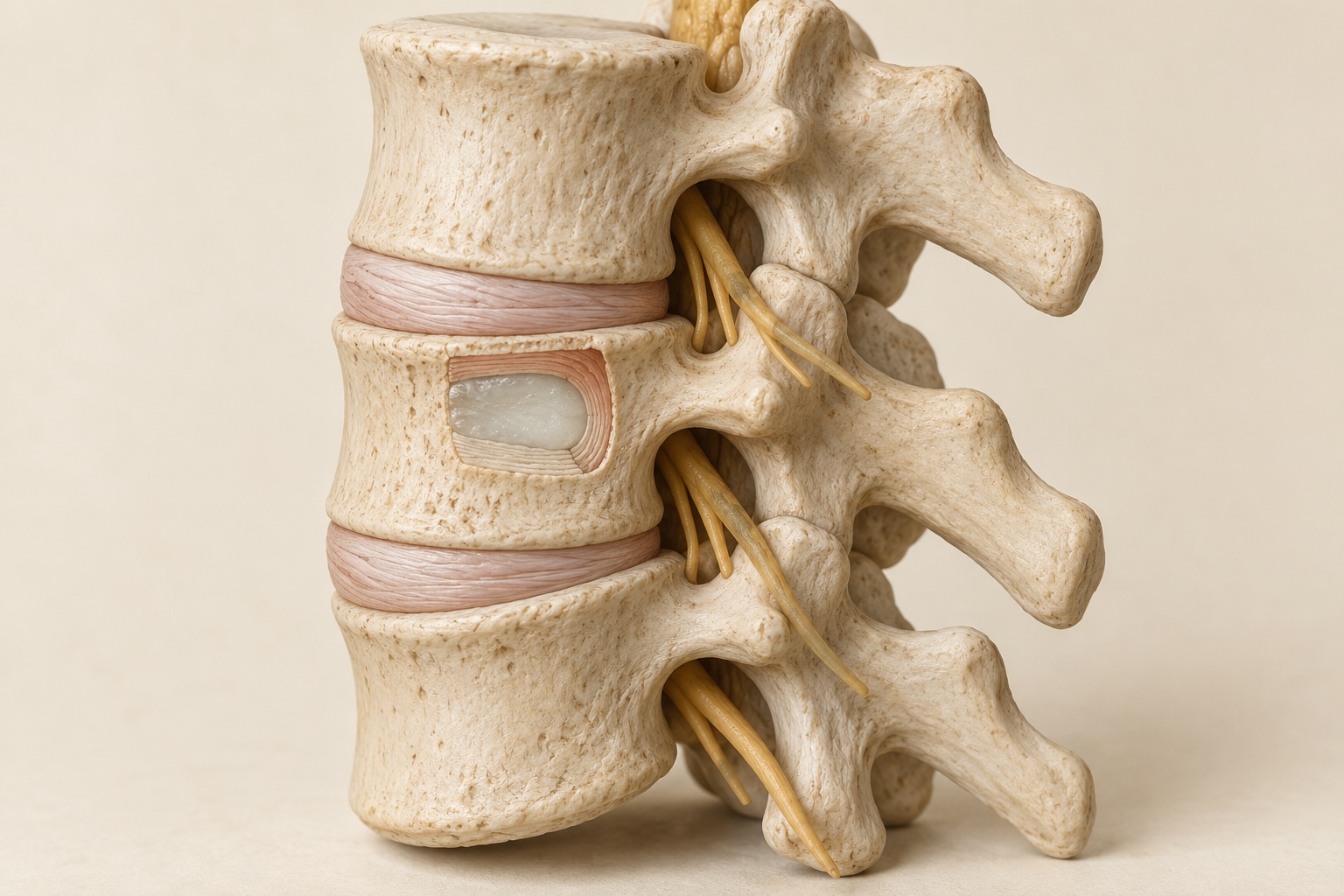
The fibrous outer disc is one anatomical structure a procedure claim may reference.
The clinical question: How is the target defined, and is the proposed effect theoretical or clinically demonstrated?
The central disc differs from the outer ring in structure and mechanical role.
The clinical question: What does the product claim to change, and how would that translate into function?
A disc procedure occurs in a region close to sensitive neural structures.
The clinical question: What procedure specific risks and neurologic assessment apply?
The proposed material is distinct from the disc tissue itself; its exact composition and intended use must be established.
The clinical question: Which product, labeling and relevant human evidence support the proposal?
A closer look
A mechanical sounding explanation can feel intuitive. The clinical review still has to define the product, anatomy and measured result before the idea becomes a treatment claim.
The outer annulus and inner nucleus are parts of a disc that functions within a larger motion segment. Describing the system as a cracked object that can simply be glued shut leaves out tissue biology, load, nearby structures and the complexity of pain.
An analogy may be useful if its limits are stated. Ask what the material is proposed to do, what has actually been measured and whether a clinical benefit follows. The explanation should not turn an intuitive picture into a guarantee that a disc becomes stable, restored or permanently repaired.
Fibrin based products can have specific medical uses, but the exact material and intended application matter. A familiar role in clotting or use as a sealant in another setting does not establish a benefit from an intradiscal injection. The review should identify the product, formulation and documented purpose.
Ask what evidence applies to the proposed technique rather than the category fibrin. If the publication concerns another formulation or anatomy, that difference should be acknowledged. A technically accurate description of the material can coexist with substantial uncertainty about a particular clinical use.
A study may involve a narrowly defined group with particular symptoms, imaging and prior care. Its findings cannot automatically be applied to everyone with a degenerative disc label. The clinician should explain both the study’s selection criteria and the reasons your situation may differ.
Ask what the researchers actually compared and how improvement was assessed. Pain scores, daily function and structural measurements are distinct outcomes. Follow up also matters because an early observation does not establish durability. These questions help interpret a study without dismissing research or overstating its reach.
An intradiscal injection involves a sensitive anatomical area, while the proposed material has its own questions. A consent discussion should address both. Technical skill is important, but it does not resolve uncertainty about the product’s benefit or every possible complication.
Ask what happens if symptoms worsen, how a complication would be assessed and who coordinates additional care. Compare established spine options and the choice to defer. A useful decision does not depend on making the alternative sound hopeless; it depends on an honest account of the options that actually fit the diagnosis.
A proposal may suggest that a material changes mechanical behavior. That claim should be assessed separately from whether a person feels better, moves more comfortably or returns to an activity. A mechanical theory can be relevant to research without providing a validated measure of individual improvement.
Ask which conclusion is supported by a human study and which remains a hypothesis. If the explanation uses stability, ask how stability was defined and measured. If it uses sealing, ask what was demonstrated rather than implied. These questions do not require you to understand every aspect of spinal biomechanics; they ask the clinician to connect technical language to an outcome you can evaluate. The answer should include uncertainty and alternatives rather than assume that a simple sounding mechanism resolves a complex pain problem. No term should function as a substitute for evidence.
A conversation example
“If fibrin is a sealant, why wouldn’t it close the problem and stop the pain?”
There are three questions to work through: what the material is meant to do, why this disc is thought to cause symptoms and whether people benefit from the procedure. Ask for the exact product and target, the reason that disc was selected and the relevant human research. If the evidence is limited or concerns another product, that matters. You also need a clear account of risk, important unknowns and appropriate spine care. A sealing analogy can explain an idea, but it cannot decide the clinical question.
The word sealant does not demonstrate that a disc is permanently repaired, that pain is eliminated or that a person can avoid other care. This educational page does not offer a fibrin intradiscal procedure.
Ask which claim is demonstrated, which is hypothetical and what information could change the recommendation. A diagnosis first spine evaluation can still be useful even when the proposed product is not supported or should not be used.
Questions worth asking
The word can sound like a proven mechanical change. Ask whether it refers to a laboratory theory, an imaging measure, a symptom goal or a measured functional outcome. A careful explanation should avoid suggesting that a disc becomes permanently “solidified.”
A class name is insufficient. Product composition, intended use and technique matter, and a medical sealant used elsewhere is not automatically established for a disc injection. Ask for exact documentation rather than relying on a familiar biological term.
The outer annulus, inner nucleus, nearby joints and nerves create a more complex picture than one MRI label. Ask how symptoms and examination support the proposal and which alternative explanations still need attention.
Ask for relevant human evidence, how outcomes were measured, the comparison used and the length of follow up. Limited evidence should remain visible. The decision also needs a plan for no improvement or a complication.
In real life
These are illustrative situations, not patient stories or personal recommendations. The details of an individual evaluation can lead to a different plan.
An illustrative proposal compares an intradiscal material to sealing a simple crack.
Analogies can help explain an idea but can oversimplify living tissue, load and pain. A plausible mechanism is not enough to establish that a person’s symptoms arise from the target or will respond to the material.
Ask which parts of the analogy are demonstrated clinically and which are theoretical.
A person receives information using fibrin and fibroid as though they refer to the same treatment.
They are different terms. An unclear name prevents a reliable review of the material, purpose and evidence. The correction needs to happen in the written proposal and consent information before any meaningful decision.
Request the exact generic and commercial names and an explanation from the treating clinician.
A small publication is described as proof that disc pain can be permanently corrected.
Study size, design, comparison group, selection and follow up all affect how much can be concluded. A result in a narrow population does not establish a guaranteed result or a universal candidate group.
Ask what remains uncertain and how established spine care compares for your actual diagnosis.
Visit field notes
Plain language
Take this with you
Your conversation checklist
What to keep in mind
Fibrin is involved in clotting; “fibroid injection” is not appropriate terminology for this spine concept.
Evidence is limited and varies by material, technique, study population and diagnosis.
The exact fibrin material, manufacturer, intended use, evidence and risks must be named.
Confirm the terminology before evaluating any claim or consent language.
Establish whether the disc is a plausible source rather than relying on imaging alone.
Compare uncertain benefit with discitis, nerve or tissue injury, increased pain and other possible harms.
Direct answers
That phrase oversimplifies the procedure and should not be used as a guaranteed outcome.
No. “Fibroid” generally refers to a type of growth; the intended term appears to be fibrin and must be clinically confirmed.
Evidence is limited and product, technique and diagnosis specific. A clinician must explain the uncertainty.
No. A responsible evaluation may recommend established care or referral instead.
Sources + editorial note
Use primary sources to check a claim in its full context. This page is educational. Personal recommendations depend on your history, examination, goals and the judgment of an appropriately qualified clinician.
Published by Paragon Regen Centers. Updated October 15, 2026. Use this page to prepare for a conversation with your clinician. Your medical history, examination and personal goals guide individual care.
Clarity before intervention
We do not promise disc restoration, solidification or a specific procedure.
Request an evaluation Email is for scheduling. Please leave diagnoses, records and private medical details out of your message.